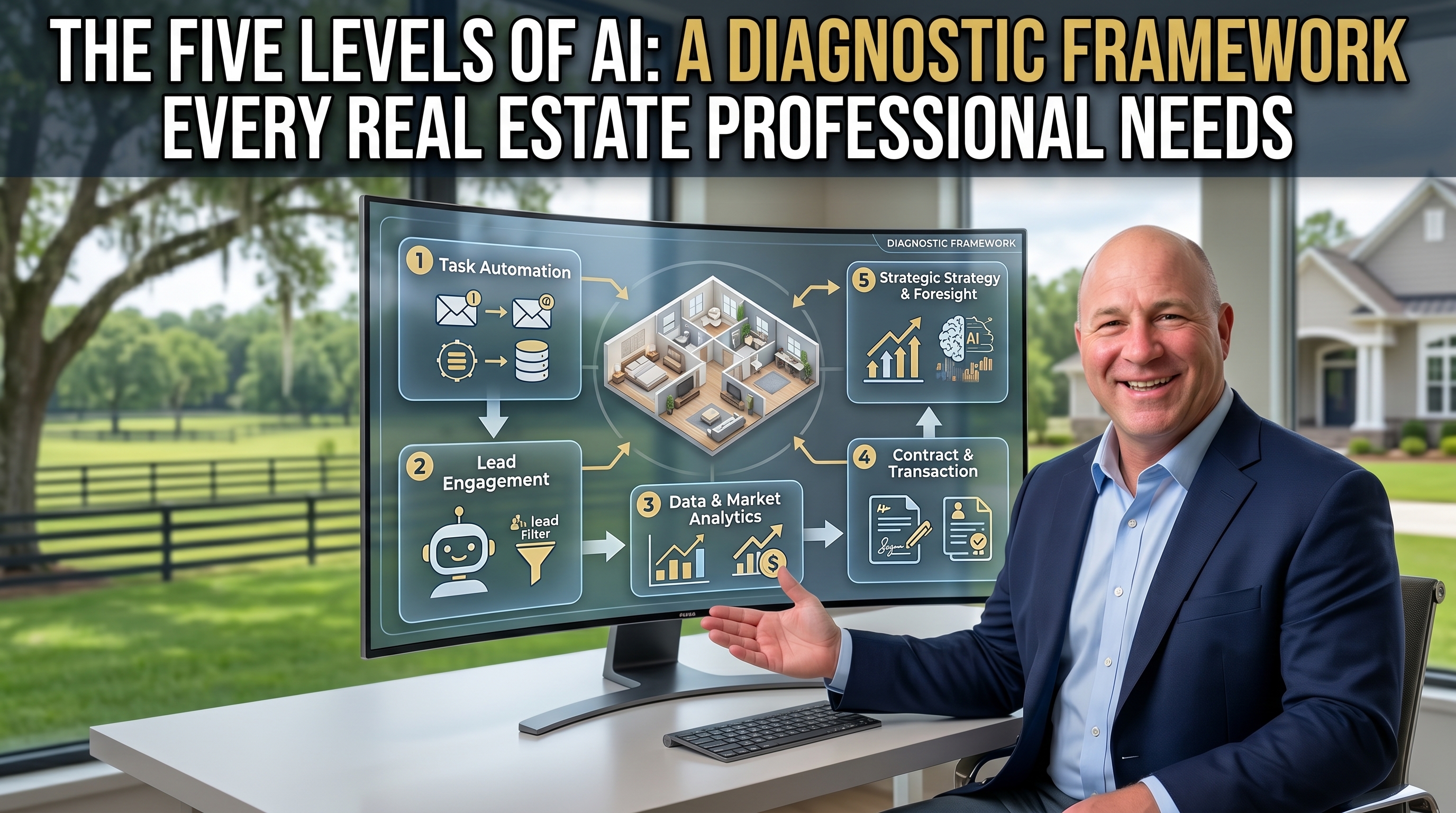
The Five Levels of AI: A Diagnostic Framework Every Real Estate Professional Needs
Lehman Strategic Partners | AI Strategy for Real Estate Professionals
When most real estate professionals first open ChatGPT, the reaction is the same: this is impressive. You type in a prompt, something polished comes out the other side, and for a moment it feels like you have found a superpower. Then you close the tab, go back to your pipeline, and the superpower evaporates. A week later you open it again, start from a blank prompt, get something decent, and close the tab again. That cycle repeats until you quietly stop thinking of AI as anything more than a clever parlor trick.
The problem is not the tool. The problem is that most people have never been given a clear picture of how AI actually matures inside a professional practice — what it looks like at each stage, where the real leverage lives, and how to know honestly where you stand. Without that map, it is easy to think you are further along than you are. And you cannot level up from a place you have not named.
Christopher Penn recently published a framework called the Five Levels of AI. The moment I came across it, I could not stop thinking about it. I have spent years working with entrepreneurs and business owners on system and process design, and this framework is the cleanest diagnostic I have seen for cutting through the noise and figuring out where someone actually is with AI — not where they think they are, not where they want to be, but where they actually are. What follows is my adaptation of that framework specifically for real estate professionals, because the industry context matters. Let’s walk through all five levels.
Level 1: Curious
At Level 1, you are aware that AI exists and you have done a little exploring. Maybe you typed “write me a listing description” or “draft a follow-up email for this buyer.” The output came back and it was fine. Maybe you used it, maybe you did not. Then you closed the tab and went back to what you were doing.
There is nothing wrong with being here. Every single person who is now doing sophisticated things with AI started at Level 1. Curiosity is the entry point. The only danger is staying here indefinitely — treating AI as something you occasionally poke at rather than something you are actively learning to deploy.
Level 1 is a starting line, not a destination. If this is where you are right now, the most important thing you can do is move intentionally to Level 2 rather than letting curiosity fade back into indifference.
Level 2: Tasking
This is where the majority of real estate professionals live right now, and it is worth being honest about that — because Level 2 feels more advanced than it is. At Level 2, you use AI for one-off jobs. A market update here, a social post there, a quick email draft when you are running behind. You know the tool works and you reach for it regularly. That already puts you ahead of most of the industry.
But here is the structural problem with Level 2: every task starts from a blank prompt. Nothing is saved, nothing is reused, nothing compounds. You are essentially hiring a temp worker for each individual job and then letting them go at the end of the day. The next time you need something similar, you start over. The results are inconsistent. The time savings are real but modest. And because nothing connects to anything else, the work does not build on itself.
The honest assessment many real estate professionals need to hear is this: if you are writing fresh prompts for every task and nothing carries forward session to session, you are at Level 2 — even if you use AI every single day. I have seen agents who have been using AI for over a year who are still firmly in this category. That honest recognition is not embarrassing. It is the prerequisite to moving forward.
Level 3: Templating
Level 3 is the first genuine unlock. At this stage, you have identified the prompts that actually work and you have done something about it — saved them somewhere, organized them, made them reusable. A Google Doc, a notes app, a folder you copy from. Same prompt structure, different listing. Same framework, different client. You have built a repeatable process, and your results reflect it.
The quality of your AI output becomes more consistent at Level 3 because you are no longer relying on your ability to reconstruct a good prompt from memory every time. You have externalized that knowledge into a system, however simple. This is what distinguishes a professional workflow from ad-hoc experimentation.
Most people who would describe themselves as “pretty good with AI” are at Level 3. And it is genuinely useful — but it is also where most people stop, which is a significant missed opportunity. Level 3 gives you consistency. The next two levels give you something entirely different: leverage.
Level 4: Systemizing
Level 4 is where the nature of the work changes. Your prompts are no longer standalone tools — they are connected. The output of one prompt becomes the input for the next. The property research feeds the listing description. The listing description feeds the social plan. The social plan feeds the seller communication cadence. You build the pipeline once, and then you run it like a machine.
At Level 4, you can press effectively one button and receive a complete listing package on the other side, or a full week of content, or an entire lead follow-up sequence. The individual prompts matter less because the system is doing the heavy lifting. You are not thinking about what to ask AI — you are running a defined workflow that you designed once and now deploy repeatedly.
This is the inflection point where AI stops saving you minutes and starts saving you hours. It is also where the compounding effect becomes real — every improvement you make to the system benefits every future run of it. The investment in building the system pays forward indefinitely. This is what it means to own a business instead of a job: you build the process, and the process does the work.
Getting to Level 4 requires the same thinking that goes into any good operational design. You have to map your workflows, identify where the handoffs are, and build prompts that are explicitly designed to pass outputs downstream. It is not technically complex — but it does require intentional design rather than organic experimentation.
Level 5: Orchestrating
At Level 5, you are not running prompts. You are running agents. The distinction matters. An agent is a system that acts autonomously within a defined scope — pulling data from your CRM, drafting content based on that data, flagging what needs your attention, and queuing up the next action. Your role shifts from executing tasks to reviewing and approving outcomes.
This is not science fiction. Real estate professionals are building and deploying agent-based workflows right now. A lead comes in, the system enriches it with publicly available data, drafts an initial outreach sequence tailored to that lead’s profile, and surfaces it for your approval before anything is sent. You review, you approve, the system executes. You are the decision-maker in the loop, not the one doing the repetitive work.
Level 5 requires intentional setup and the right tools, and it requires a solid foundation beneath it. You cannot build Level 5 on a Level 2 foundation. That is the most important structural point of this entire framework. Agents are built on top of systems, which are built on top of templates, which are built on top of repeated use. The levels are not arbitrary categories — they are a genuine developmental sequence. Each one creates the conditions for the next.
The Honest Assessment Most Professionals Need to Make
Here is what experience has shown consistently: most real estate professionals who engage with AI seriously are at Level 2. A meaningful portion have made real progress into Level 3. Very few have reached Level 4, and Level 5 remains genuinely rare in the industry.
What makes this framework valuable is not the categories themselves — it is what the categories make possible. When you have a clear picture of where you actually are, you can make a clear decision about where you want to go and what it will take to get there. Without that picture, you are navigating without a map. You might work harder, add more tools, spend more time with AI — and still not move up, because you are optimizing within a level rather than building the foundation for the next one.
The question worth sitting with is not where you want to be. It is where you actually are right now. Be specific. If your prompts are not saved anywhere, you are at Level 2. If they are saved but not connected to each other, you are at Level 3. If you have built connected workflows that run end-to-end, you are approaching Level 4. That honest assessment — however humbling — is the only starting point that leads somewhere.
Building the System That Funds Your Freedom
The Five Levels framework is ultimately about the same thing that drives all great business design: moving from reactive to intentional. A Level 2 practitioner is reactive — reaching for AI when they need something and starting from scratch every time. A Level 4 practitioner is system-driven — operating a defined process that produces consistent, scalable output regardless of how busy or distracted they are on a given day.
The goal is not to use AI more. The goal is to build the kind of practice where the systems do the repeatable work and you spend your time on the decisions that actually require you. That is what it looks like to own a business instead of a job. AI is one of the most powerful tools available right now for building that kind of operation — but only when it is deployed as a system, not as a series of one-off tasks.
If you are ready to stop experimenting and start building, that is exactly the work we do at Lehman Strategic Partners. We help entrepreneurs and small business owners — including real estate professionals — design the systems that let them stop owning a job and start owning a business. Reach out if that is where you are headed, or join the conversation in the AI Prompts for Real Estate Professionals Facebook group, where we do this work together every day.