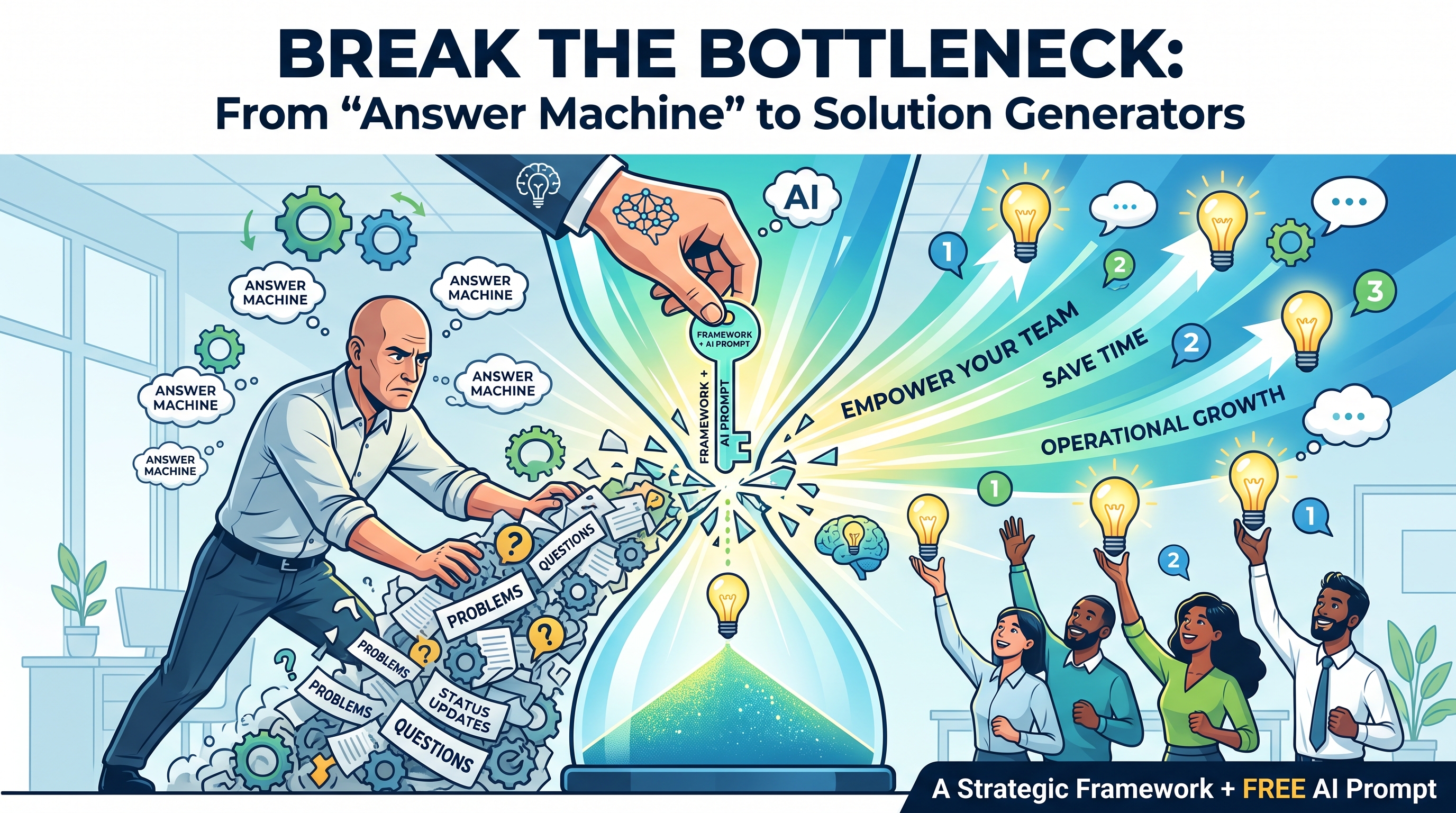
Stop Being the "Answer Machine": How to Empower Your Team and Streamline Problem Solving with AI
If you own a business, manage a team, or lead operations, especially in a fast-paced industry like real estate or property management, you have likely fallen into a very common, very dangerous trap. At some point in your leadership journey, you became the company’s "Answer Machine."
Every question routes through your desk. Every minor decision waits on your approval. Whenever a bottleneck forms in your operations, you look around and realize that you are the bottleneck.
If you are brutally honest with yourself, there is a part of you that probably likes it. Being the person with all the answers strokes the ego. It feels like you are providing immense value. It feels like exactly what a leader is supposed to be doing. You built this business, you know the systems better than anyone else, and naturally, people come to you when they are stuck.
But here is the hard truth: playing the Answer Machine is costing your business more than you think. It is stunting your team's growth, halting operational improvements, and draining your most valuable resource, your time.
At Lehman Strategic Partners, we focus on helping professionals build better systems, utilize AI, and scale operations. Today, we are going to talk about how to break the Answer Machine habit, why it's secretly hurting your bottom line, and the exact 3-step framework (powered by a simple AI prompt) that I put in place to fix it.
Why We Become the "Answer Machine"
There are two primary reasons managers end up solving everyone else's problems.
1. The Identity Trap Being the one who has the answer is deeply tied to how we see ourselves as leaders. It feels like tangible value. When an employee walks into your office confused and walks out with clarity, you feel productive. Because you designed the operational machine, you assume you are uniquely qualified to fix its gears.
2. The Speed Trap The second reason is much more pragmatic: nobody argues with you, and it is simply faster. You can usually solve an escalating issue in five minutes. Watching an employee struggle for two hours to arrive at the same conclusion is painful. It costs the business money in lost productivity, and frankly, it tries your patience. The instinct is to swoop in, say "Just do it this way," and move on.
But the last thing any business owner wants is to pay talented team members to burn half a day on a problem that could be solved in ninety seconds. That isn’t noble; it’s operational waste.
However, your instincts are only half right. The desire for efficiency is correct, but the method, you solving the problem for them, creates a toxic operational loop.
The Hidden Cost of Constantly Providing the Answer
When you are always the answer, you get efficiency today, but you hit a permanent ceiling tomorrow.
Your people stop building their problem-solving muscles because they never have to use them. They quickly learn that the shortest, most efficient path to overcoming an obstacle is to walk into your office.
When this happens, your business stops improving. It doesn’t stop improving in the big, obvious ways, you’re still steering the macro vision. It stops improving in the small, critical details.
True operational growth lives in the minutiae, the details you are no longer close enough to see. If the only person allowed to think critically about those details is you, the company will never get any better. You are operating from a 10,000-foot view, trying to solve ground-level problems.
You are answering questions, but you are accidentally training your team to just come back to you for the next one.
The Realization: They Actually Know Better Than You
When I recognized this pattern in my own operations, I tried an experiment. I started forcing people to bring me their own thinking before I would give them an answer.
What I discovered completely changed my perspective on leadership.
Their solutions weren't just adequate, they were often much better than mine. Not just sometimes, but almost all the time.
It makes complete sense when you step back and think about it. Your team members are the ones doing the actual work every single day. They are in the trenches, dealing with the angry clients, navigating the software bugs, and managing the vendors. They see the systems from the inside out.
When I tried to solve their problems, I was looking at the situation from a level up and usually about two weeks behind the actual reality of the workflow. I wasn't saving them time; I was being a bottleneck and actively overriding their superior, boots-on-the-ground insights with my own outdated assumptions. That realization stung, but it forced a necessary change.
The 3-Step Framework for Team Problem Solving
To fix this, I implemented a very simple rule. If you want me to help you solve a problem, you have to bring it to me in a specific format. You cannot just walk in and drop a mess on my desk.
The submission must contain three parts:
A clear description of the problem. (What is actually happening?)
What you have already tried. (What steps have you taken to resolve it?)
Two potential solutions you are considering. (What do you think we should do?)
Let me be incredibly clear: this framework is not a wall designed to keep people out of my office. I never want my team to feel like they are abandoned on an island or that they can't ask for help when they are genuinely stuck.
The point is not to block the conversation. The point is to force the thought process that needs to happen on the way to the conversation.
When we rolled this out, two amazing things happened: First, a massive percentage of the time, the problem never even made it to my door. The act of sitting down to figure out Step 3, generating two potential solutions, forced the employee to actually look at the problem objectively, and they ended up solving it themselves. Second, when they did come to me, instead of spending 30 minutes asking diagnostic questions just to understand the issue, we had a highly focused, 5-minute conversation about which of their two great solutions we should execute.
Enter AI: The Ultimate Thinking Partner
When we first instituted this, it was a heavy lift for some. People had to run this framework in their heads, and not everyone was used to thinking this way. Some adapted instantly; others struggled.
Today, there is no excuse for that struggle, because we have Artificial Intelligence.
You can now hand your team the framework as an AI prompt and let a tool like Claude or ChatGPT walk them through it. I built a specific prompt that acts as a practical thinking partner for my team.
Here is how it works: The employee opens Claude, pastes in the prompt, and states their problem. For example, a property manager might say: "Owners keep calling and emailing me for status updates on their work orders. It’s eating up four hours a week, and I can't get ahead of my actual turnover work."
Instead of just spitting out a generic answer, the AI is programmed to act like a manager. It asks refining questions one at a time. It forces the employee to articulate exactly what they have tried. Finally, it helps them brainstorm options.
By the end of a 5-minute chat with the AI, the employee generates a one-page summary detailing the exact problem, the history of attempts to fix it, Option A, Option B, their personal recommendation, and exactly what they need from me (their manager) to move forward.
They can read that one-pager to me in 60 seconds, and we can make an immediate, highly informed decision. It removes the friction, trains their critical thinking, and keeps the business moving at lightning speed.
How to Implement This Tomorrow
If you want to introduce this to your team, I have one crucial piece of advice: Do not announce this as a massive new company policy.
Nobody wants another cumbersome corporate policy to memorize. Instead, just give the framework (and the AI prompt) to your team. Tell them plainly what it is for: to help them organize their thoughts and solve roadblocks faster.
Then, lead by example. The next time you need to take a problem to a partner, a vendor, or even a team member, run your issue through the framework first. Show them what it looks like to present a problem alongside its potential solutions.
If you stop acting like the Answer Machine and start expecting your team to bring their brains to the table, your business will transform. You will build a culture of proactive problem solvers, your operations will improve in the details you can't even see, and you will finally win your time back.
Try it on the very next problem that lands on your desk. See how far your people can get without you. I promise, you will be surprised.