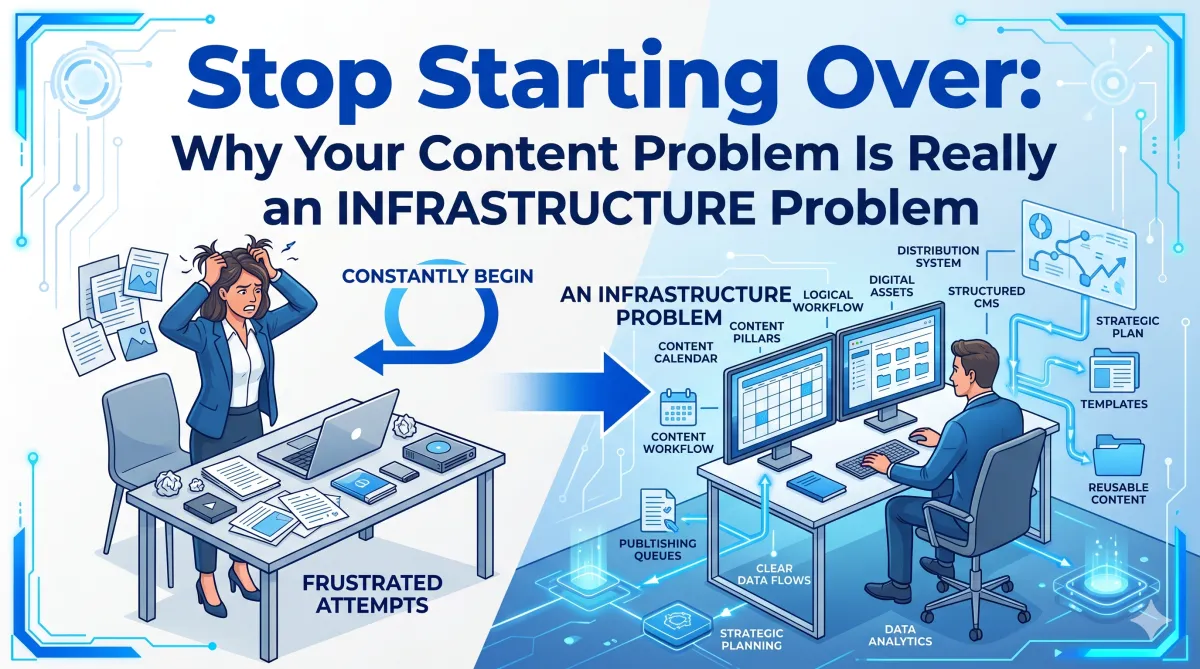
Stop Starting Over: Why Your Content Problem Is Really an Infrastructure Problem
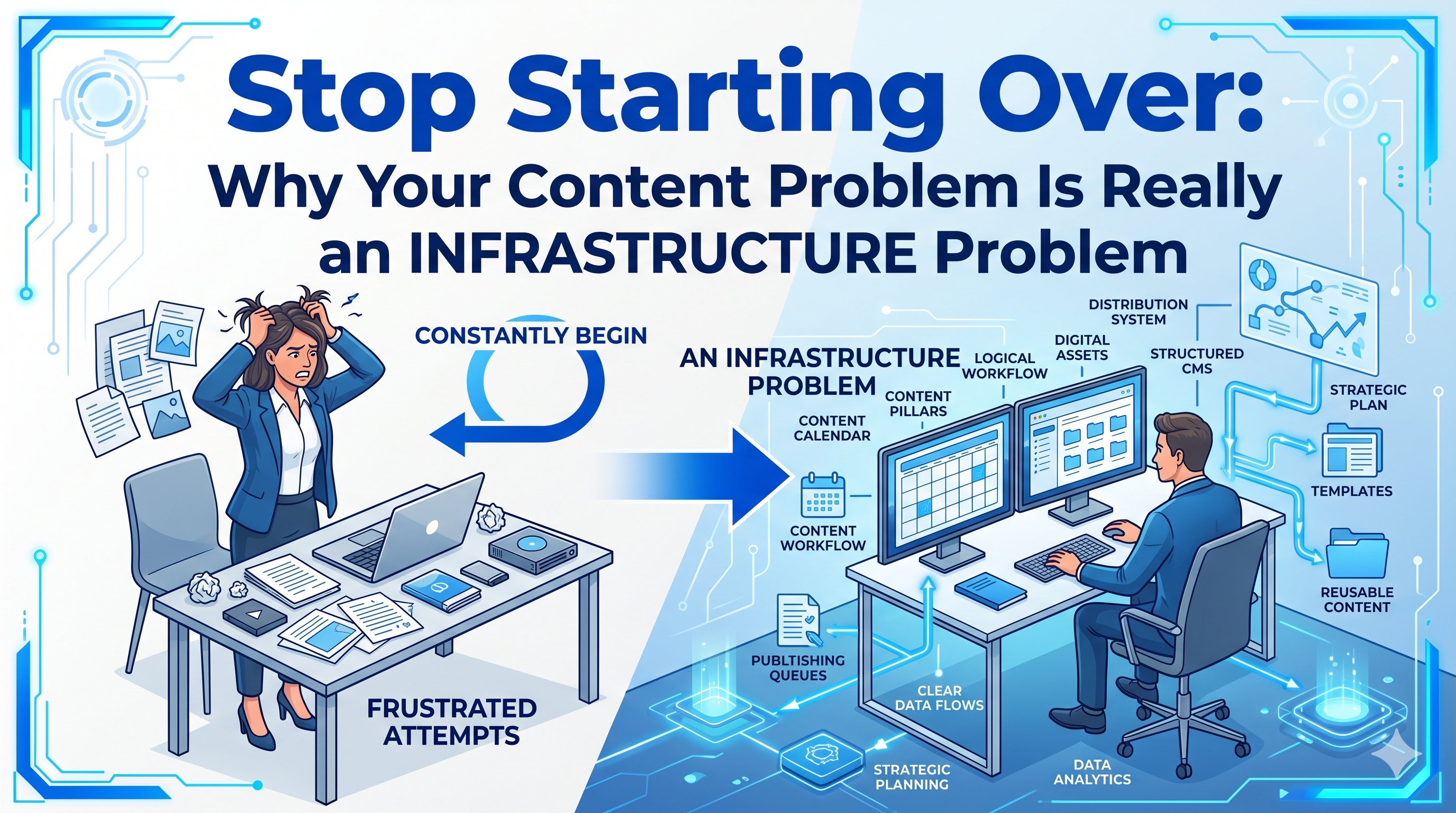
There is an entrepreneur in your industry right now who seems to have cracked the code on content. Consistent output. Real engagement. Their name is everywhere — and from the outside, it looks like a gift you don't have or a secret you haven't figured out yet.
It is not a gift. It is not magic. Once you see how it actually works, you are going to realize you have been trying to solve the wrong problem entirely.
The Cycle That Keeps You Stuck
Most business owners, when they decide they want to show up more consistently online, make the same first move: they go looking for inspiration. They follow others in their space. They scroll for trending topics. They try to think of something clever to say.
And every now and then, it works. They have a good week. They post a few things, maybe even get some traction. But then life intervenes. A client crisis. A deal that needs attention. Back-to-back commitments that eat the calendar. The content stops.
Two weeks go by. Then a month. Then the guilt sets in — and the guilt makes it even harder to start again. The cycle repeats.
If this sounds familiar, you are not alone. And the frustrating part is what most founders conclude from this: that the solution is motivation. That if they could just get on a roll, just find something they would actually stick to, everything would click.
Motivation is not the problem. The problem is infrastructure.
What Infrastructure Actually Means
Every time you sit down to create content without a structure in place, you are making a hundred small decisions at once. What do I talk about? Who am I talking to? What platform? What format? What is the point of this post? Is this too promotional? Is it interesting enough?
That is not a creative challenge. That is decision fatigue — and your brain responds to decision fatigue the same way it responds to any other overwhelming task: it procrastinates, it avoids, it tells you to do it later.
The founders who are winning at content are not more creative than you. They are not more motivated. They have simply eliminated most of those decisions ahead of time. They know their audience. They know their content pillars. They have a repeatable weekly structure that tells them exactly what kind of content to create on any given day.
The creativity happens inside the framework — not in spite of the absence of one. That is the magic trick. It was never magic. It was infrastructure.
The Three Pillars of a Content Infrastructure
Building content infrastructure does not require a team, a big budget, or hours of planning. It requires three decisions made once and documented clearly.
Know Your Audience with Precision. Not a vague demographic — the actual person you are talking to. What keeps them up at night? What decision are they stuck on? What do they wish someone would just say plainly? When you can answer those questions, content stops being a blank page problem and starts being a conversation you already know how to have.
Define Your Content Pillars. Content pillars are the three to five recurring themes your business has the authority and genuine interest to speak about. When you have pillars, you never start from zero. You start from a category, then find the specific angle within it. The constraint is what creates the output, not what limits it.
Build a Repeatable Weekly Structure. Consistency is not a character trait. It is a schedule. What type of content goes out on which day? What format? What platform gets what? When these decisions are made in advance, showing up becomes a process you run — not a willpower battle you fight every morning.
Where AI Fits — and Where It Does Not
A lot of founders are using AI for content the wrong way. They open a tool, type something like "write me a post about my business," and get something generic that does not sound like them, does not connect with their audience, and either never gets published or gets posted and goes nowhere. Then they conclude that AI does not work for them.
Here is what is actually happening: AI did not fail. The infrastructure was not there for AI to run inside of.
AI is not a replacement for the thinking. It is an accelerant once the thinking has been done. Once you know your audience, your pillars, and your structure — once you know what you are creating, who it is for, and what it needs to accomplish — AI becomes extraordinarily powerful. It helps you get past the blank page. It speeds up execution. It lets you produce in fifteen minutes what used to take two hours.
But the structure has to come first. AI is the engine. You still have to build the car.
The Decision Framework That Changes Everything
The founders who appear to be winning everywhere online are not showing you talent. They are not showing you someone with more time than you. You are seeing the output of a decision framework they built once — and now they just run it.
That is replicable. That is learnable. And it is far simpler to set up than most people expect.
Think about the difference between a founder who sits down every Monday wondering what to post, versus a founder who sits down every Monday with a clear category to work from, a format already decided, an audience already defined, and a tool that handles the drafting. One is fighting the blank page. The other is running a system.
The gap between those two founders is not talent or time. It is one documented structure.
This is what it means to own a business instead of a job. When you own a job, every task is a fresh decision and a fresh energy expenditure. When you own a business, the decisions are made at the system level. You execute. The system handles the thinking.
Content is no different from any other function in your business. If you would not run your operations without a repeatable process, you should not run your content without one either.
Stop Starting Over
The next time you find yourself staring at a blank screen wondering what to post, or feeling guilty because the content has fallen off again, stop treating it as a motivation problem. It is an infrastructure problem. And infrastructure problems have clean, buildable solutions.
Define your audience. Lock in your pillars. Build your weekly structure. Then let your tools — AI included — work inside that structure. The cycle of starting and stopping does not end because you get more disciplined. It ends because you eliminate the decisions that were draining you in the first place.
That is the work. And it is worth doing once so you never have to start over again.